
Quantum Consciousness
Is that what's going on in our brains?

Abridged version reprinted from Healthy Living Is Good Medicine, with permission of the author, Mick Skolnick, MD.
There are some mind-bending possibilities about what it means to be a conscious human being, wide awake and fully aware of our internal and external experiences. I’d like to explore some of them here.
There is no unifying definition of consciousness, and it is urgently needed. The philosopher, Thomas Nagel, considered consciousness to be the total subjective experience of what it is like to be you. The neuropsychological perspective is that consciousness is the inseparable relationship between an unbounded field of awareness and the transitory appearances of objects within it.
Any apparent distinction between objects that we perceive and the sense that we are a separate, perceiving self, is an illusory projection of the ego or self-concept. Our fictional, self-constructed identity has no existence beyond the confines of our imagination. In other words, our sense of self is an illusion.
Mindfulness is a cognitive skill that is usually developed by consciously paying attention to the present moment, or through certain kinds of meditative practices that are aimed at dispelling the illusion. The goal of such practices has been referred to as “enlightenment,” a more awakened state of consciousness that exists beyond the duality and linearity of conventional thought processes.
Scientists have been studying the neural correlates of consciousness (NCC), which refers to the relationships between mental states and corresponding neurophysiological states. There appears to be a minimum amount of neural activity within the brain that is necessary for a specific conscious experience to occur. NCC research has focused on identifying precise brain regions and processes directly involved in conscious perception.
The “hard problem” of human consciousness involves understanding exactly how people are able to have their subjective experiences in the first place. Discovery of the mechanisms within the brain that enable consciousness to emerge has eluded scientists for centuries. For philosophers, the nature of consciousness also remains a mystery. One of the difficulties in solving the problem is that there is no agreed upon protocol for measuring the content and intensity of conscious experiences in an observer-independent manner.
Just to be clear, quantum consciousness is a legitimate field of study that’s very different from quantum-woo mysticism and the pseudoscience exemplified by Deepak Chopra’s “quantum soul” and miraculous “quantum healing.” Quantum consciousness relies upon certain aspects of quantum mechanics that can theoretically take place in the brain and account for some critical areas of consciousness that can’t be completely explained by the classical physical and chemical processes of neural physiology.
Quantum Theory
Quantum theory describes and explains the properties and behavior of physical matter at and below the scale of atoms. It is based on the premise that matter simultaneously exists in two forms; as a particle and as a wave. The particle nature of matter is described by deterministic classical physics such as Newton’s Laws. The wave nature of matter is described by probabilistic quantum physics.
Atomic and subatomic particles follow rules that are very different from those enumerated by classical physics. Quantum theory has proven to be the most important development in physics over the last 100 years. It permeates every modern technology in use today, from computer transistors, atomic clocks, and GPS navigation systems, to MRI scans, lasers, LEDs, electron microscopes, and the LIGO detector of gravitational waves.
Matter at the atomic and subatomic level is studied by scientists working in the field of quantum physics, which involves the interpretations and applications of quantum phenomena. Quantum mechanics refers to specific mathematical tools that are used to study, describe, and predict quantum phenomena involving the wave properties of elementary particles.
Notable among these phenomena is “quantum entanglement,” in which different particles can instantaneously interact across vast distances. Another is “quantum superposition,” in which particles can exist in two or more states or positions at the same time. When observed, the state or position of these particles “collapses” and the system becomes confined to one definitive state or location. The phenomenon of “wave-particle duality” is another aspect of quantum physics. This video clearly (and humorously) explains a thought experiment involving quantum superposition:
A quantum computer uses “qubits” which can exist in superposition and be both 0 and 1 at the same time. This enables them to perform complex calculations on multiple possibilities all at once, leading to an extremely high processing speed compared to traditional computers, which rely on bits that are either 0 or 1.
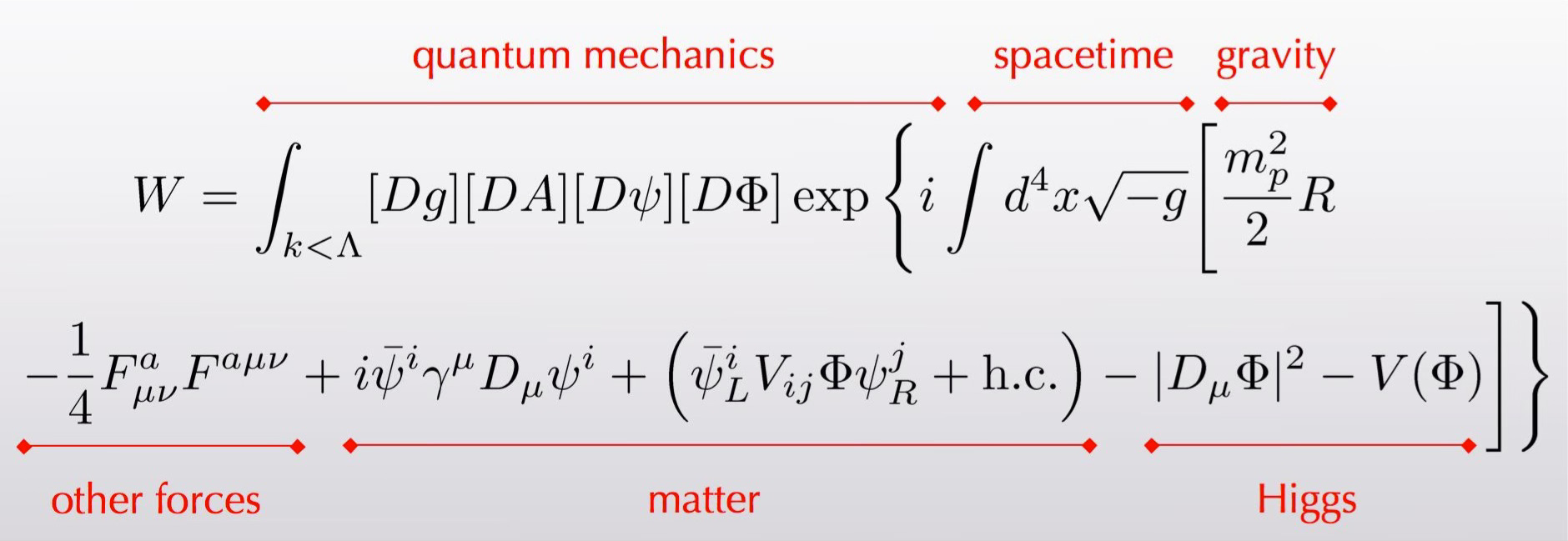
If these concepts, such as Schrödinger’s cat, are difficult to grasp, it’s because mathematics is the native language of physics. To truly understand quantum mechanics, you would have to understand the underlying mathematical formulas and calculations. Attempts to translate from the mathematics into plain English can at best produce metaphorical expressions that hint at the underlying reality, and at worst, create stupefying confusion.
In simple, metaphorical terms, quantum entanglement is a phenomenon in which two particles become linked in such a way that they share the same fate, regardless of the distance separating them. If a property of one particle is measured, such as its spin, there will instantly appear a corresponding property in the linked particle. Einstein referred to this observation as “spooky action at a distance” and doubted its validity. It is unfortunate that he didn’t live long enough to see the experimental evidence, known as the “Cosmic Bell Test,” supporting the validity of quantum entanglement.
In theory, “space” as we perceive it could be a projection of quantum entanglement, emerging from the interconnectedness and non-local correlations of quantum particles. This concept implies that space-time is not a pre-existing entity, but instead arises from the underlying quantum interactions and their entanglement properties. A mathematical framework already exists, wherein space is represented as a network of interconnected nodes, with entanglement holding the network together.
Back to the Brain
At its deepest level, the human brain is made up of atomic and subatomic particles, but as a “warm, wet, and noisy” environment, it has been viewed as being unsuitable for maintaining quantum states. Interactions of particles with a biological medium can cause decoherence and prevent entanglement. However, some researchers have proposed mechanisms, and presented evidence, suggesting that quantum entanglement could indeed occur in the brain.
This has become a fascinating and hotly debated topic. While there is no consensus, there are some intriguing research findings and theoretical arguments that suggest it may be possible. In their quest to understand consciousness as a physical phenomenon, some scientists hypothesize that the quantum realm may hold the key, but a paucity of experimental evidence leaves many others skeptical.
It has been suggested that quantum entanglement could play a role in the synchronization of neurons, which is crucial for various brain functions such as cognition and awareness. Entanglement might also allow for faster and more efficient communication between different brain regions.
Experimental Evidence
The myelin sheaths that surround and insulate nerve fibers in the brain could potentially shield quantum states and allow entanglements to occur. Experimental studies have shown that these neural structures can actually produce pairs of entangled photons.
Another hypothesis proposes that the microtubules, which are structural components within neurons, could be sites for quantum processes, including entanglement. Theoretically, quantum computations in the microtubules could contribute to consciousness. Some experiments using modified magnetic resonance imaging (MRI) techniques have produced evidence of correlated proton spins in the brain, which could be interpreted as a confirmation of entanglement.
Xenon anesthesia is a key area of research in the quest to understand the potential role of quantum mechanics in consciousness and brain function. Xenon is a “noble” gas, meaning it is chemically inert and doesn’t readily react with any other substances. This makes it a good candidate for studying its subtle interactions in the brain, without it causing chemical changes.
Xenon has been used as an anesthetic for decades, but its mechanism of action has long been a mystery. Unlike many other anesthetics that bind with specific receptors in the brain, xenon’s effects seem to be more general, suggesting it has a very different type of action.
The xenon atom has nine stable isotopes; atoms with the same number of protons but with different numbers of neutrons in their nuclei. Two of these isotopes have a nuclear spin (a quantum property), and seven do not. A key experiment explored how four of xenon’s different isotopes, with variations in nuclear spin, affected anesthesia in mice. Isotopes with a nuclear spin had reduced anesthetic potency compared to those without a spin. This suggests that a quantum property such as nuclear spin can influence observable biological effects such as the state of consciousness.
Some researchers propose that xenon might interact in the brain to form “radical pairs” with atoms having unpaired electrons. If these unpaired electrons become entangled, their quantum states are linked. It’s hypothesized that this entanglement could be crucial for consciousness, and that that xenon’s anesthetic effect might be due to its disruption of these entangled states in the microtubules. This hypothesis suggests that Xenon anesthesia interferes with these quantum processes, leading to a loss of consciousness.
The xenon experiments provide indirect evidence that quantum properties such as nuclear spin, and the potential entanglement of radical pairs, can have an influence upon consciousness. This strengthens the argument that quantum phenomena might play a role in brain function.
However, the xenon experiments only show that quantum properties might be able to affect consciousness within the context of anesthesia. So far, the evidence produced by research on xenon anesthesia challenges conventional understandings of consciousness and leads to the possibility that quantum mechanics may play an important role in how our brains work.
Ongoing Research
Some scientists argue that the effects of xenon can be explained by classical mechanisms, such as its interaction with the electron clouds in protein molecules. Consequently, more research is needed to fully understand xenon’s mechanism of action and to confirm the role of quantum entanglement in the brain.
The Allen Institute is exploring quantum mechanics and the role that it might play in human consciousness. A recent article explores the conjecture that quantum processes create our conscious experiences.
Meanwhile, there’s a debate going on about whether consciousness arises from a collapse of quantum superposition, or from its formation, in which the complexity of consciousness depends upon the number of potential states that are in superposition.
If this article has boggled your mind, welcome to the club. Simply allow these concepts, no matter how confusing they may be, to stimulate deeper thinking about the subject, and especially about the origins of your own conscious awareness. We can all reap many benefits from knowing ourselves better.
Ask yourself, “Where am I, when I am the observer of that which I observe, the experiencer of all that I experience, the knower of all that I know?” Where is the subject that relates to all objects? Can I locate in space and time who it is that has sensations, perceptions, memories, fantasies, and all these thoughts and feelings about things? What is the source of my awareness?”
“There are more things in heaven and earth, Horatio, / Than are dreamt of in our philosophy.” ~ from William Shakespeare’s “Hamlet.”